Venture × Infrastructure Manifesto
The Opportunity
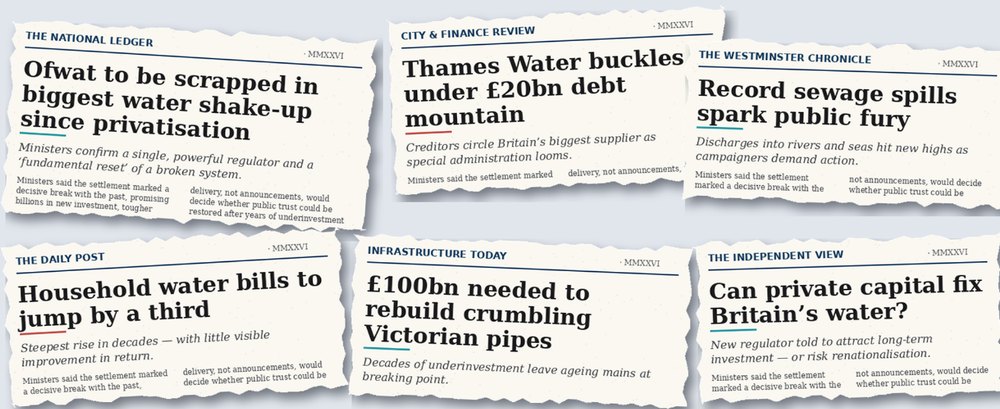
Infrastructure is at a pivotal moment. Its historical replacement cycle is coinciding with an accelerating opportunity to set the foundation for civilisation’s next transformative advance. McKinsey determines $106 trillion in required infrastructure spend through 2040.
Most of the developed world’s infrastructure stock was built during the post-war decades and is reaching end of life simultaneously: 25% of UK water mains are over 100 years old, 40% of Europe’s grid is over 40 years old, and the US infrastructure scorecard is graded C by The American Society of Civil Engineers. Climate change is compressing the timeline for renewal; with the 1.5°C threshold now breached, the IEA projects ~$5tn of annual energy investment needed to stay on Paris-aligned pathways. Densifying cities face strains on housing supply, inner-city mobility, and municipal services; 75% of 2050’s urban infrastructure is yet to be built. These pressures are compounded by geopolitical protectionism that disrupts supply chains, restricts access to critical minerals, and demands reshoring outsourced infrastructure.
Piling on top of renewal investment is surging AI capex ($1 trillion & growing by the end of 2027). The data centre megatrend dwarfs the mobile or fibre capex cycles of the 2000s and reaches other infrastructure verticals: energy (500TWh incremental demand), water (a semiconductor fabrication plant uses millions of gallons daily), mining (critical rare earths), and engineering (qualified technician shortage). For AI to deliver as promised, for people as much as for agents or robots, the foundational infrastructure must get built.
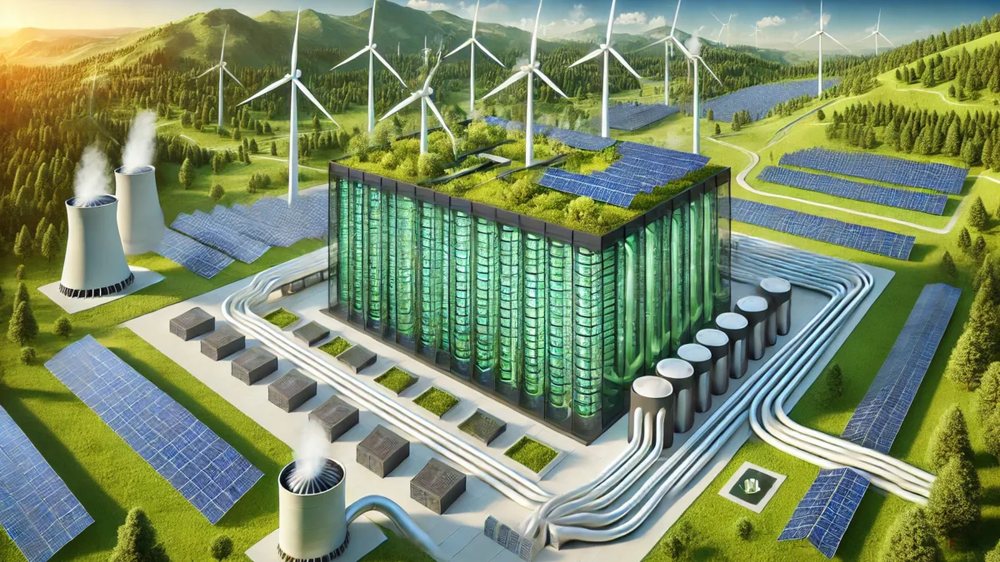
We believe the companies that will capture major value in the impending $100 trillion infrastructure investment cycle will be tech-native. Incumbents will need to implement technology to build and operate more efficiently, safely, and resiliently. Start-up Infra-to-X “I2X” platforms founded on tech-first principles will emerge to create new categories or disrupt incumbents tied to legacy systems. If these pioneers can scale innovation down the risk curve they can achieve “core+ infrastructure” status: mature critical services businesses characterised by high barriers to entry, predictable cash-flows, and continued growth potential.
The definition of core+ infrastructure has historically evolved as technology breakthroughs become infra-ready. The industrial revolution is the closest comparable to today’s AI revolution: energy demand surged and innovation derisked, from Brunel’s railways to Edison’s Pearl Street station, Faraday’s dynamo, and Bell’s switchboards. Next came fibre over copper, mobile over fixed-line, hyperscale data centres over enterprise server rooms, lithium-ion grid storage over peaker plants. Infrastructure funds prove this evolution in their core+ portfolios.

The next waves of core+ infrastructure companies are venture-stage today. Innovative infrastructure solutions are emerging across critical services, waste treatment, water tech, resource extraction, climate adaptation, an outer space economy, gigaton-scale carbon removal, magnitudes more clean baseload power, and increasingly connected digitisation. Scientific breakthroughs in robotics, quantum, or fusion, combined with regulatory reform and R&D support for university spin-outs, make this a remarkable moment to build towards core+ infrastructure. AI is the accelerator that supports innovators to develop, test, and build faster than ever before, and its impact is only compounding. Now is the opportune moment to seed entrepreneurs creating the next-generation infrastructure layer. Those we believe will revolutionise their sector will be characterised by an Infra-to-X “I2X” business model.
Next-generation I2X platforms transform the infrastructure layer from the ground up. They provide their customers (whether individuals, businesses, government, or other infrastructure companies) with a recurrent supply of critical outcome as their trusted utility. That could be an electron, molecule, datapoint, connection, delivery, pathway, compliance certificate, mandatory maintenance, waste treatment, or any other essential service. Their innovation – whether software, hardware, or a disruptive business model – is embedded into their operations in order to deliver their infrastructure outcome more safely, efficiently, or resiliently than incumbents. That contrasts with a Business-to-Infrastructure “B2I” company, which sells its innovation as a product to incumbents for incremental operating gain. B2I adoption is notoriously slow: compliance, uptime, and procedure leave entrepreneurs stuck in “pilot purgatory” before a single utility signs.
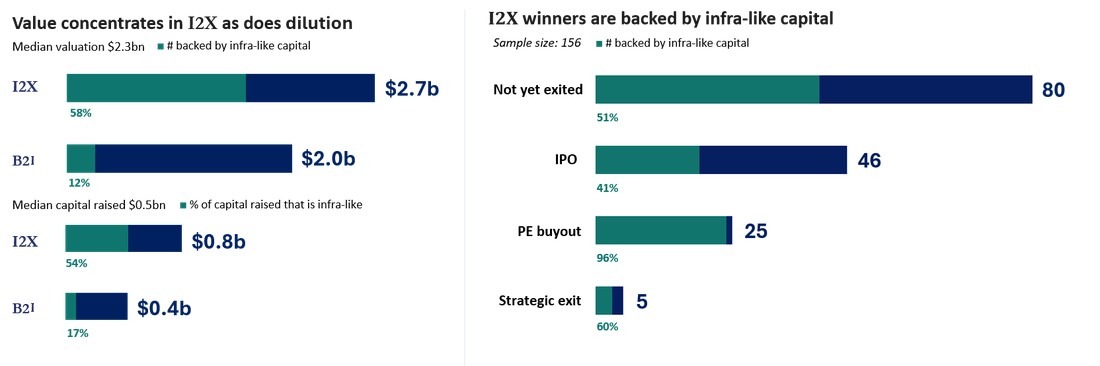
We analysed c.400 InfraTech “winners”: innovative companies founded in the 21st century that have since achieved $300m+ valuations worth >$5tn in aggregate. Excluding parent-funded spin-outs, we found that the I2X platforms were 4x more valuable than B2I InfraTech companies on average, representing c.40% of the count but >75% of the value. As power law dominates we take a closer look at the median: whilst the median I2X platform remains more valuable than its B2I comparable, it has also raised more [infra-like] capital. Although dilutive to early investors, infra-like capital signals infra-ready status from which dividends yield and exits materialise DPI.
We focus singularly on building next-generation I2X platforms. Not only because the I2X business model provides the stronger customer and financial proposition, but importantly because innovating the infrastructure layer from the ground up is how infrastructure truly revolutionises.
In practice InfraTech companies do not strictly classify as I2X or B2I. We classify InfraTech companies into four distinct categories based on where a start-up could position at a “steady-state.” That reflects their potential after a decade of high-growth (i.e. not where it is today at pilot stage).
| B2I INFRATECH | I2X INFRATECH | |||
| B2I PRODUCT | B2I SUPPLIER | I2X SERVICE | I2X ASSET | |
| Business model | B2I companies provide innovative products as a component to their customers (which sits in the infrastructure sector). The customer is responsible for adopting innovation and implementing it to their workflows. | I2X companies are platforms that are the infrastructure layer: delivering critical outcomes to their customers (in any sector). Innovation is embedded in its operations to provide a stronger outcome for their customer. | ||
| Margin sustainability | B2I product companies compete against many alternatives; margins likely erode. | Both B2I suppliers and I2X service providers are qualified and embedded into customer workflows. Price schedules may face supply-demand pressures. | I2X asset owners benefit from structural barriers to entry e.g. permits, licences, capital intensity. | |
| Run-off value | The next sale. Typically unbankable until low churn is demonstrable over time. | Limited: outstanding order book and low-value fleet/facility. | Quasi: multi-year frameworks with minimum-volume guarantees, redeployable fleet/facility. | High: take-or-pay offtakes on contracted assets; unlocking lower-cost core infra capital to scale. |
 |
OUT OF SCOPE | OPPORTUNISTIC
Potential to reposition as an I2X service
|
ACTIVE
Service so critical it becomes the infrastructure layer
|
SWEET SPOT
Build-to-core+ infrastructure classification
|
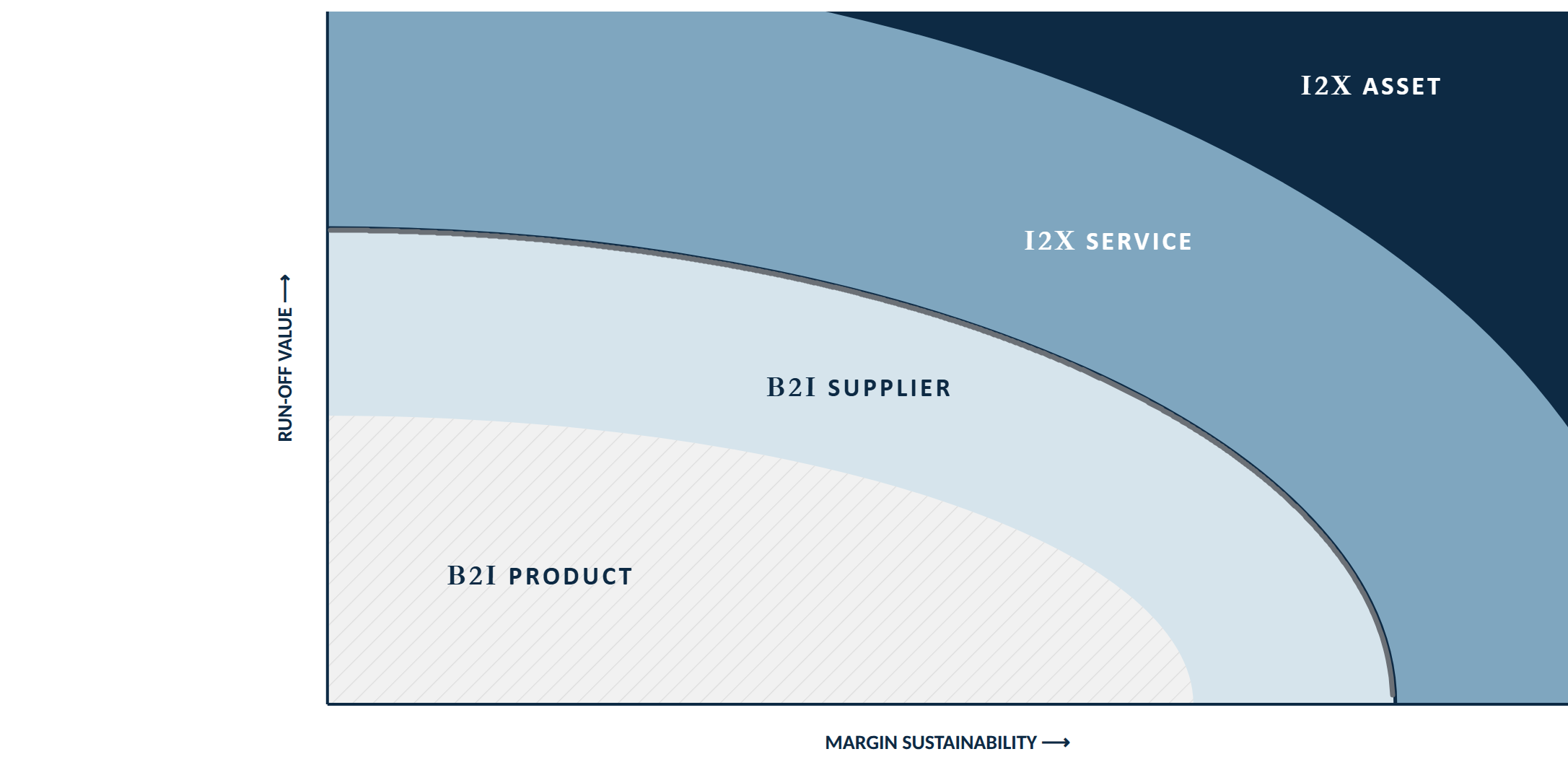
Our Venture × Infrastructure strategy is designed to back entrepreneurs on their journey “up and right” on our chart into a more valuable and sustainable I2X platforms at full potential. That includes opportunistically repositioning a B2I supplier as an I2X service provider through structuring commercialisation and capitalisation (for example securing framework agreements that protect margins over supply-demand cycles).
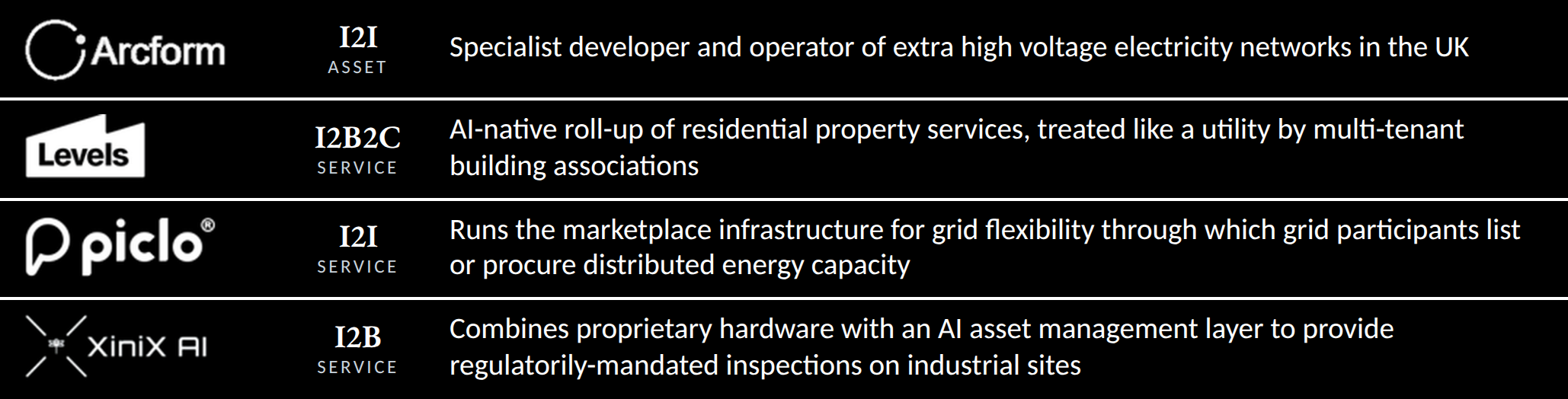
Your Journey
There are very few investors in the venture world who understand the ins & outs of infrastructure execution needed to build I2X platforms. Whilst venture capital had its origins in hardware (semiconductors, chips, satellites), the vast majority of venture dollars over the last 10 years have been deployed into B2I software, consumer, and fintech applications. The venture playbook of ship early, fail fast, and forgiveness over permission does not build infrastructure, which operates on structured offtakes, regulatory compliance, and reliable uptime.
There are even fewer investors in the infrastructure world who can stomach venture conviction. Institutional equity, asset-backed lending, and project finance are designed to underwrite contracted cash flows of tangible assets. Infrastructure investors are not geared up to support entrepreneurs who hire on equity promises, pivot to find product-market-fit, or settle co-founder disputes. The certainty that infrastructure capital demands does not permit taking risk on venture-stage businesses; it waits until next-generation platforms are infra-ready.
Infrastructure entrepreneurs have had to compromise on their investment partner: either take venture money that lacks depth of infrastructure execution, take infra money that lacks venture conviction, or get overlooked by both. Too asset-heavy for venture capitalists, too risky for infrastructure investors. What they really need is venture equity at the outset that can shape a maturity path to infrastructure capital over time. We founded Actia because venture does not have to be the antithesis of infrastructure. We are the Venture × Infrastructure intersection.
Actia’s mission is to be the specialist Venture × Infrastructure investment partner that entrepreneurs choose on their journey from pilot to core+ infra-ready. We enter at TRL6+: this is the venture stage where an innovation is pilot-demonstrated in its relevant environment with resultant operating data. From pilot begins a journey of commercialising operations, scaling engineering, and upsizing capitalisation to become infra-ready. The journey de-risks with funding from across a financier’s portfolio: Actia seeds the early stages (high risk/return); secures selective scale-up capital (equity, debt, or hybrid as relevant); and positions growth alongside maturity for public or private core+ infrastructure equity to crystallise value (lower risk/return). Pharma is a parallel sector of paramount operating compliance, technical sector understanding, and derisking milestones (FDA Phase 1/2/3). Specialist venture firms have established a path from early clinical trials to pharma-ready. We plan to do the same for infrastructure from pilot to core+ infra-ready.
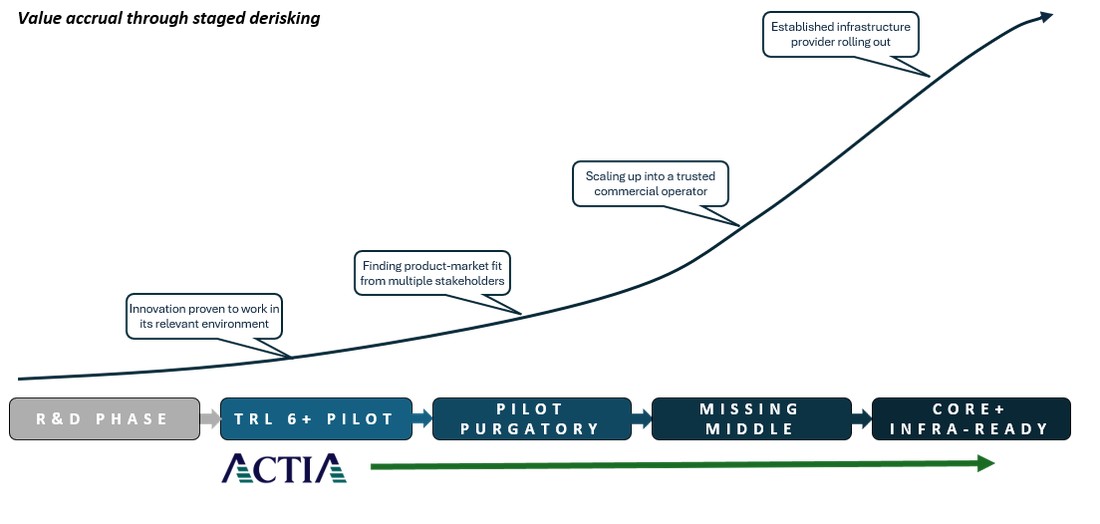
Commercial viability in infrastructure is fundamentally different to other venture sectors. Utilities cannot tolerate outage: a single fault can incur penalties, lose customers, and damage regulatory reputation. Drinking water, residential heating, or traffic lights simply cannot just stop. Five nines (99.999% uptime) is the gold standard for data centres: that translates to no more than five minutes of downtime in a year. Multiple risk-averse stakeholders (utilities, lenders, regulators) need to build trust before implementing unproven technologies. Getting out of “pilot purgatory” requires demonstrating reliable operating data to overcome stakeholder inertia; not just showcasing ROI, but meeting cybersecurity thresholds, safety compliance, operating consistency, and proving product-market-fit beyond the customer for the wider regulated industry.
Developing infrastructure at scale is a lengthy process of getting through the “missing middle”. Certifications, planning consent, and environmental permits are all pre-requisites which often run in siloed workstreams. These are part of a known course for building the three-thousandth wind farm, but a first-of-a-kind “FOAK” project has numerous unknowns including engineering challenges to get consistent or scaled-up production. Stacked regulatory, market, engineering, offtake, financing, and execution risks must be hurdled before commercial operations can begin “COD”. Growth is step-change rather than J-curved, resulting in binary outcomes in which a single point of failure in the process can jeopardise the entire project. Reaching 90% of the target is actually a 0: building 90% of a bridge does not carry 90% of the traffic. The result is a funding gap, the “missing middle” where innovators cannot get scale-up capital to complete their journey. Without the FOAK the learning curve never costs down to widespread deployment. Technologies which get almost there are filed away in the “Lost Ark Warehouse”.

We work through these challenges with our portfolio entrepreneurs at board level, aligned with the vision we share as their early, high-conviction backers: hiring experienced team members from the infra world, securing offtakes with blue chip customers, structuring the capital stack, and positioning the platform for infra-ready status in a way that navigates the “missing middle”.
Reaching the finish line together is highly rewarding. Once delivering critical outcomes repeatedly at scale, innovative solutions become equally difficult to retract, replicate, or replace. Certification, regulatory approval, brownfield integration, and performance reliability trust all combine to create switching or set-up costs that typically exceed price. Securing recurring cashflows with blue-chip customers strengthens these moats. That revenue certainty unlocks cheaper, and more abundant scale-up capital to fund mega-scale rollouts, further entrenching market position. Margins are elevated by providing essential services protected by monopoly characteristics. Many I2X platforms sit within natural monopolies (grid connection within a service area, port logistics in a corridor, water treatment for a municipality); even where pure monopoly is regulated away, the regional oligopoly that follows tends to produce durable margin structures. Tangible assets cannot be disrupted overnight by innovation or market downturns. As a result, established I2X platforms get backed by core+ infrastructure capital and trade at premium steady-growth multiples (typically 15-20x+ EBITDA).
Our Partnership
We are invariably entrepreneur-centric. Foremost, we find exceptional people to back. Our team, backers, network, operations, and portfolio founders are world-class. We hold ourselves and the entrepreneurs we back to that same exceptional bar. The most telling signal for us is their ability to attract and retain A-team talent. Secondly, we look for their unique right to win at scale within their category. Operating excellence, technical genius, and unfair distribution matter more for different teams. Lastly we need alignment for our partnership: in motivations (vision, ethics, culture) and commitment (incentives, resilience, adaptability).
We prioritise setting the right partnership. The bottlenecks, megatrends, and adoption curves all point towards hundreds of successful infrastructure innovators emerging over the next decade. The abundance of opportunity means we do not need to operate out of “FOMO”. The reason we exist is not simply to pick the winners; beyond capital we offer our expertise, network, and reputation. We choose to work with entrepreneurs who appreciate our partnership style as their strategic sounding board, linking arms through challenging times, and growing together over the long term. Our contribution makes a pivotal difference to getting the commercial traction that breaks out of “pilot purgatory” and setting an infrastructure capital path through the “missing middle”. That earns us the right to win allocation on disciplined terms, and what ultimately delivers alpha to our own investors.
“Outstanding infra knowledge, valuable strategic input at board level, and a wide network of partners”

“The best networked, expert backers in this space doing a fantastic shift helping us, really appreciate it. Very happy”

“Conviction at exactly the moment we needed partners who could see scale”

“Patient capital, deep domain expertise, and a network that genuinely opens doors”

Our diligence process empowers us to source and underwrite what others cannot at the Venture × Infrastructure intersection. We are immersed in the infrastructure world where our network spans operators, asset owners, regulators, and institutional capital providers who adopt or validate innovation. We update our top-down thesis and run ideas past them continuously over monthly catchups. We run expert-led due diligence where the questions we collectively ask are the ones that matter. Introducing entrepreneurs to potential team members, commercial partners (e.g. utilities or offtakers), and downstream funders as part of that process gives them a taster of our value-add beyond capital. Putting our own capital in from the outset takes our conviction to a level that few other investors can match.
We are also deep in grassroots innovation, through relationships with universities, accelerators, angels, and venture capital. Countless opportunities are directed our way. Our preferred sourcing channel is referral from someone world-class backing another. Those leads are recursive from our core ethos of curating the investment partnership that exceptional infrastructure entrepreneurs deserve.
Our ambition does not stop at seed investing. Like the entrepreneurs we work with, we also think big. The megatrends of today amplify the need for specialist Venture × Infrastructure investors to mature the venture path for InfraTech entrepreneurs with Core+ Infra ambitions to parallel what BioTech did for Pharma. The network effects of operating at a world-class level will generate us ever more right to win across the risk curve as we scale our own capital base.
Our name Actia derives from Actium, a seminal Roman naval battle that followed decades of testing, adopting, and scaling marine innovation: ship-mounted ballista, two-banked galleys, and ports built on hydraulic concrete. The result: naval victory that rebirthed the Roman Empire into its golden age. Rome was not built in a day, nor was the Battle of Actium won in one. We are just getting started at Actia.