
AI-Powered Roll-Ups: A Primer
Infrastructure is not only the asset. It is the services that keep the asset working between capex cycles: the facility manager who runs the building; the contractors who maintain the grid, the water network and the highways; the firms that test the fire systems, clear the drains, and collect the waste.
Taken together these are some of the largest service sectors in the country. Thousands of small firms, mostly owner-run, most employing fewer than ten people, many still on 1990s systems, margins in the 5-15% range, and customers that are very sticky. These are businesses ripe for consolidation (that’s been the private equity playbook for decades) where integration is synergistic and creates platform value. They are also ripe for technology disruption yet culturally undisposed to implement new technology. Herein lies the AI-powered roll-up opportunity.
AI has changed what it costs to run these firms. Look at where a managing agent’s cost base actually sits: it is people, and most of what those people do is administration. Service charge budgets and year-end accounts, reconciliations, the compliance diary across fire, gas, electrical, lifts and asbestos, Section 20 consultations, insurance renewals, chasing contractors for quotes and certificates, and the same resident queries arriving by phone and email all day.
Almost none of that needs human judgement. It needs the right document found, the right rule applied and the right person chased, which is what agentic AI now does well, end to end and across every building at once. Once Supa’s operating system is in, its teams report admin falling by up to 90%. The cost per home falls, and the people who remain are doing the work only people can do.
Robotics and IoT are starting to do the same for the physical side: inspection drones for roofs and facades, crawlers for pipes and ducts, sensors and predictive maintenance that tell you which lift will fail before it does. Together they could take an operator from 10% margins to 60%+, more like a technology company.
A SaaS vendor sells their product on the premise of cost-savings achievable once the customer implements it. In these sectors the buyer is a small operator who has never bought software before, does not really understand what is being sold, and whose incentives run against making it work: the owner is a few years from selling the business, and the staff being asked to adopt the tool are the cost it is meant to cut.
The vendor is paid on the sale, not on the outcome; the data migration, the retraining and the process redesign fall to a customer with neither the capability nor the obligation to finish. Implementation failure is one of the leading causes of churn, by some estimates the majority of it. Silicon Valley’s response has been to hire forward-deployed-engineers to guide customers through that change: whilst that might work within multi-billion dollar-spend clients, that customer acquisition model is too expensive for small services businesses.
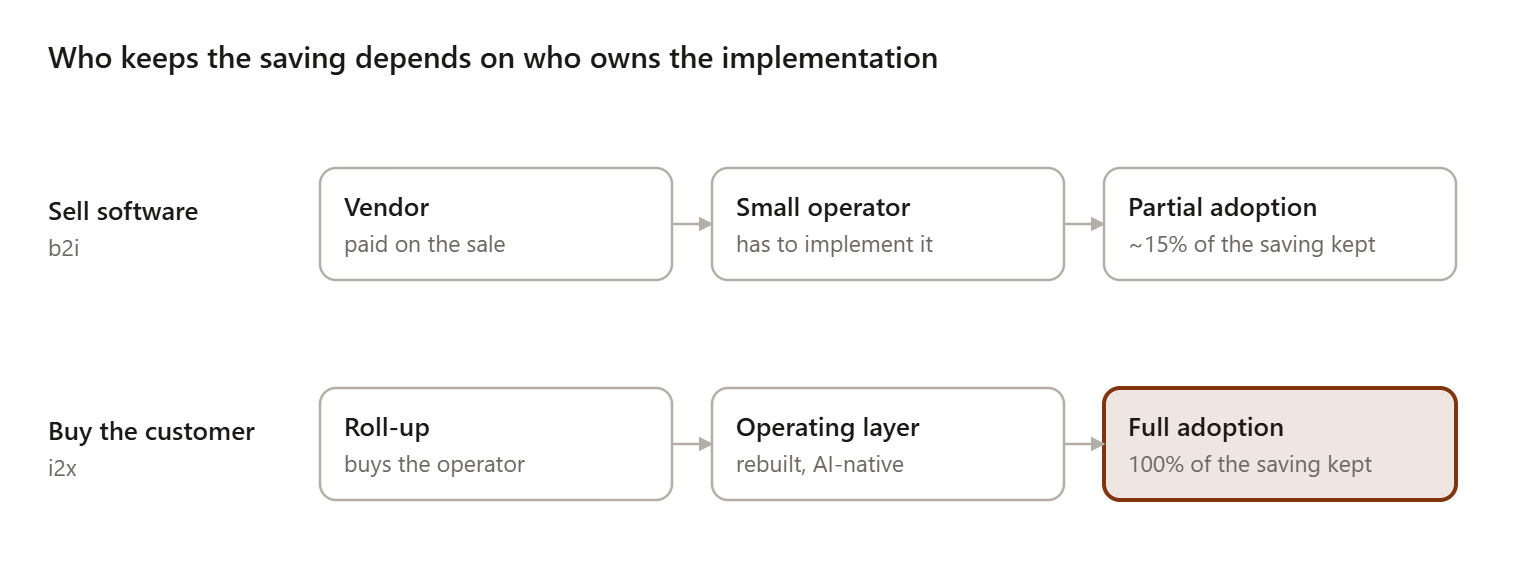
We believe the most effective way in is to buy the customer instead of selling to them. An AI-powered roll-up acquires the operating business, keeps the people and the local name, and rebuilds the operations layer underneath them as an AI-native operating system.
It gets full control over workflows, data and change management, which is the part a vendor never gets: no sales cycle, no unsophisticated buyer to persuade, no partial adoption. Whist a software vendor would capture a slice of the efficiency it creates through their subscription fee, often around 15% of it, the AI-rollup owner keeps 100% of it.
Roll-ups themselves are not new. Private equity has been buying dentists, vets and accountancy practices for thirty years, and the honest record is mixed: scale was bought and the margin was supposed to follow. The old roll-up inherited each firm’s systems and cost base and hoped procurement savings would do the rest.
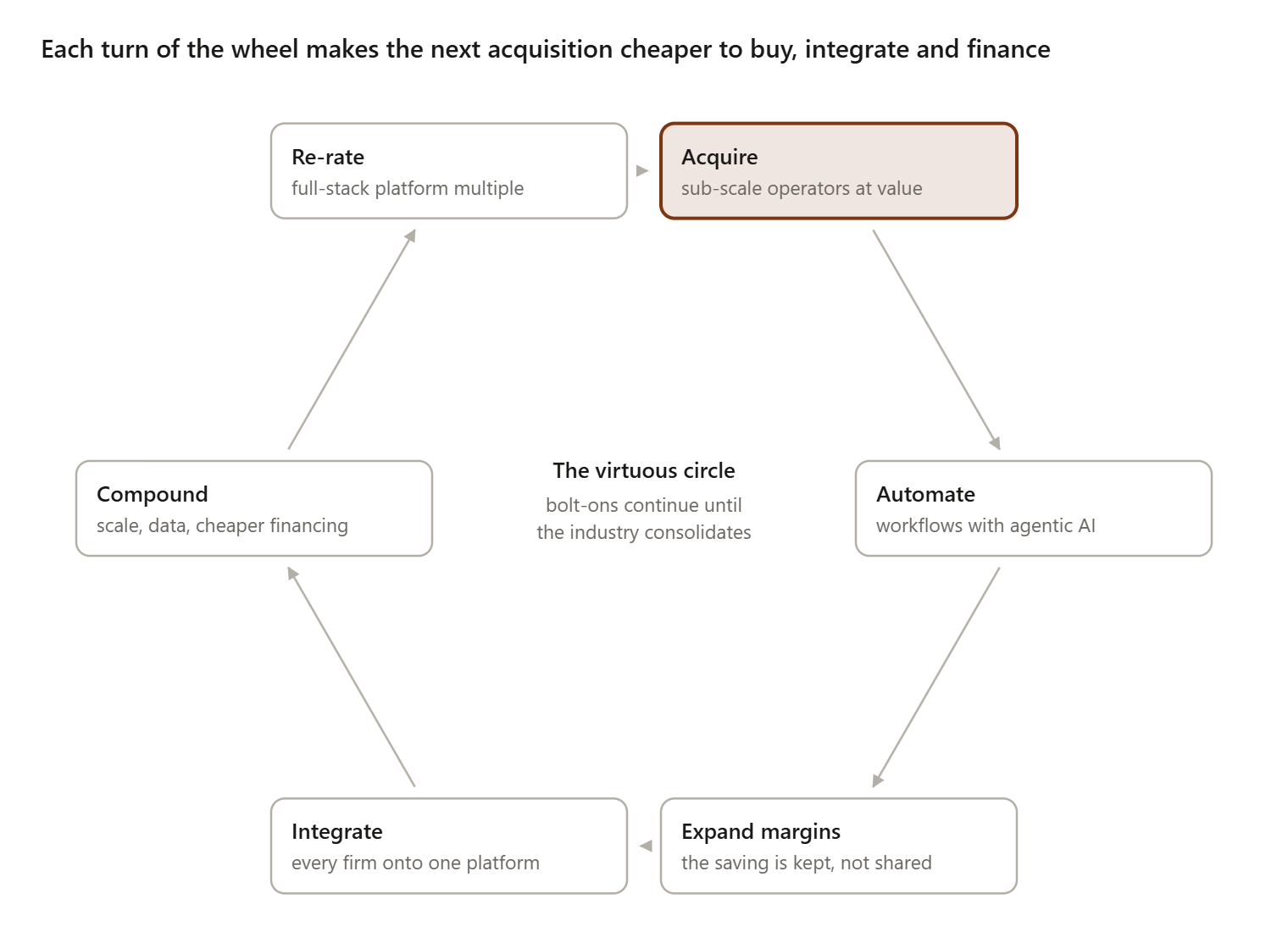
The AI-powered version replaces the back office of every firm it buys with one it built, owns and keeps improving: a vertical AI operating system with a data flywheel, where each acquisition adds data and edge cases to a platform that gets better at the job. The tenth firm integrates faster than the first.
Integration is where the margin is actually made, and it is a playbook rather than a one-off. Each acquired firm moves onto one ledger, one compliance engine, one contractor network and one contact centre. Insurance, utilities and maintenance get procured once for the group rather than firm by firm.
The local brand and the property managers stay in place; what disappears is the back office each firm used to run on its own. Done for the second firm it is slow. Done for the seventh it is routine, and every home added spreads a largely fixed platform cost a little thinner.
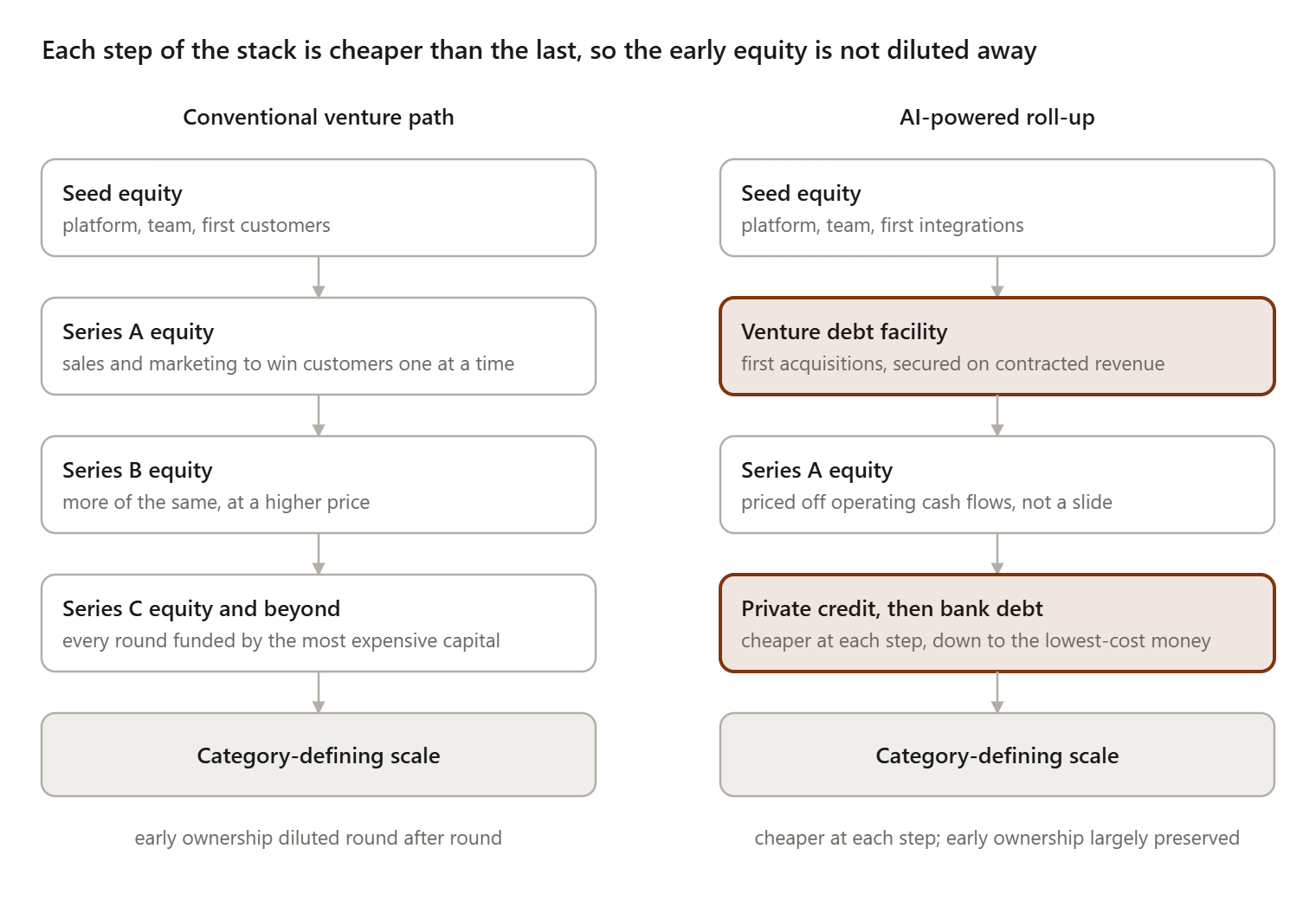
Venture equity can finance the first few acquisitions on language it understands: LTV/CAC. In a segment where churn is <5% and margins could reach software-like 60%+ territory post AI implementation, LTV/CAC could be more like 10/1 than typical VC-backed SaaS businesses at 5/1.
That said, venture is the most expensive money a company can raise. Using it to buy revenue at one times is actually not its best use once the business gets to scale. The acquired book is contracted, essential and low-churn, which is to say bankable, and a lender will finance it at a fraction of the cost.
So the stack splits, and then it evolves as the group proves itself. Seed equity funds the things only equity can: the technology, the team, the first integrations that prove the playbook. Series A and venture debt funds the next wave of acquisitions against the cash flows they bring with them as the M&A playbook and margin expansion stories prove themselves.
After that the debt gets cheaper at each step: private credit once the cash flows have a track record, then bank debt, cheaper again, as the group reaches the scale at which it can be financed like the infrastructure services business it is.
The company arrives at category-defining scale having raised a fraction of the equity a pure software or marketplace business would need to get there.
Actia’s InfraTech Thesis
i2x: become the infrastructure, don’t sell to it
Our Actia InfraTech thesis centres on i2x, “infrastructure-to-x”: building platforms that become the infrastructure layer, delivering a critical outcome to a customer, rather than b2i, “business-to-infrastructure”: vendors selling a product to an incumbent and waiting out pilot purgatory. The SaaS problem in the primer is the same split under another name.
Most writing on AI roll-ups leads with multiple arbitrage: buy at a services multiple, sell at a technology one. That is the result, not the cause. Why the model works comes down to the two axes we look at with an infrastructure lens: run-off value and margin sustainability.
Run-off value: what is being bought
A managing agent, once appointed, is very rarely replaced; tenures run well past a decade and annual churn sits in the low single digits. A small firm of that kind changes hands at a low single-digit multiple of earnings, often around one times revenue.
To a venture investor that price is the customer acquisition cost, and what it buys is a fully contracted, recurring book in a single transaction. Compare the SaaS business that spends about a fifth of revenue every year on sales and marketing to win customers one at a time, and then loses a slice of them annually.
Put the two side by side on a profit basis. Lift the margin by rebuilding the work, hold the churn where it already is, and lifetime value runs to roughly ten times the acquisition cost, against the five times a good SaaS business is benchmarked at. The number matters less than what it tells you: the book has run-off value. It would be worth something to the next owner even if nothing else were done to it, and that is what a lender underwrites.
Margin sustainability: who will not catch up
The second axis is the one most people miss. The usual objection to AI margins is that everyone gets the same tools, so the advantage competes away within a few years. In most software markets that is right.
Here the competitor set is thousands of owner-run firms with fewer than ten people, owners mostly in their fifties, and industry estimates that a large share of them will retire within the decade. They are among the slowest to adopt new technology and the least able to implement it: no IT department, no integration budget, and no appetite for a two-year migration in the run-up to selling the business.
The AI-native vendors trying to sell to them hit the same wall. So the margin gap between an AI-native operator and the rest of the sector does not close. It widens, and the firms on the wrong side of it become the acquisition pipeline rather than the competition.
Fragmentation and succession, which a growth investor reads as a weak market, are exactly what make the margin sustainable.
Of the four conditions in the primer, the first three are margin sustainability and the fourth is run-off value. The same two axes as our manifesto, applied to businesses that happen to be made of people rather than pipes.
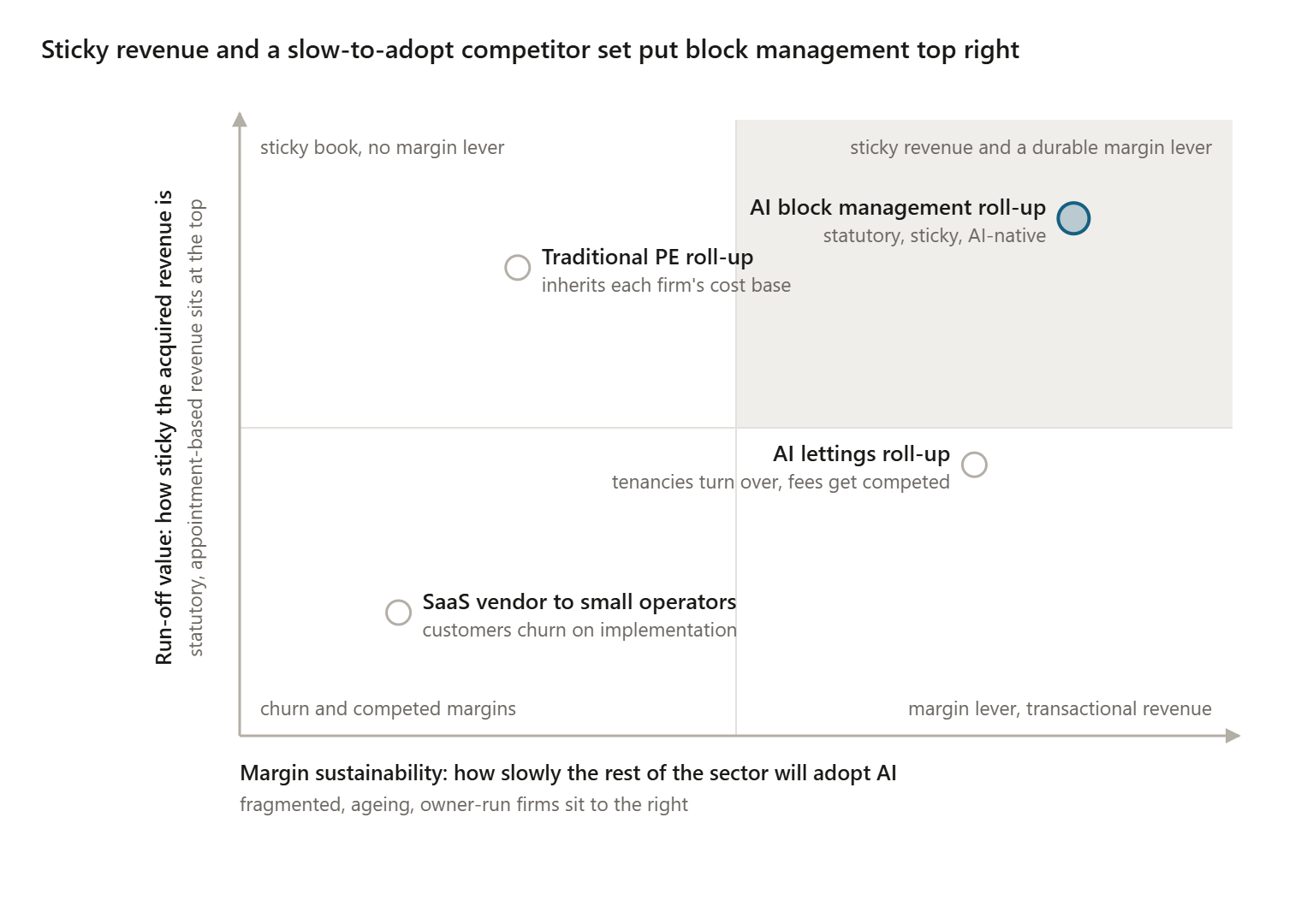
In our manifesto we described how an i2x platform earns its way to lower-cost core infrastructure capital over a decade, once its revenue is certain enough for lenders to underwrite. An AI-powered roll-up in the right industry starts there. The revenue it buys is already certain. The journey up and right on our chart is compressed from a decade to a few years, and far less of the dilution that normally comes with it needs to happen.
Returns: what the two axes are worth
The re-rating, a services multiple going in and a technology platform’s multiple at scale, follows from the margin expansion and the stickiness of what was bought.
For the early investor that changes the maths in a way that is easy to understand and hard to find elsewhere. We get in at seed pricing on a business whose growth is funded after the first couple of years mostly by someone else’s cheaper money.
The downside is cushioned by the run-off value of what has already been bought, and by acquired businesses that generate cash while the platform is still being built. The upside is the platform re-rating. Put those together through the Series A and you have something venture rarely offers: an asymmetric outcome, with a downside closer to an infrastructure services business and an upside closer to venture, and far less of it given away along the way.
What makes one of these an Actia investment
Plenty of roll-ups will be pitched with “AI” in the name over the next two years. Most are private equity deals with a new logo. Our filter is the one we apply to everything else, with two additions.
i. The service must behave like infrastructure. Demand that is statutory or contractual, an appointment that is rarely lost, and a permanent asset base underneath it. That is what makes the revenue bankable, and bankable revenue is what makes the capital stack work.
ii. The founders must have operated in the industry, not just studied it. Integration is where roll-ups die. The owner retires, the institutional knowledge leaves with them, and the records turn out to be a filing cabinet and a spreadsheet. The AI is only as good as the operational context it is trained on, and that context has to come from people who have run the work.
iii. The technology must be owned and deployed, not licensed and layered. Rebuilding the operations layer of every acquired firm is the whole point. Buying firms and installing a third party’s software on top is the old model, relabelled.
iv. Capital discipline from the start. Debt against contracted revenue is the opportunity; debt against hoped-for margin is the trap. We want to see the technology proven on the first acquisitions before leverage does any heavy lifting, and a structure that keeps the company flexible while integration costs are still high.
Key risks on our mind
We should be clear about what we are not saying. We are not saying AI roll-ups are easy, or that every fragmented industry is a candidate, or that the debt is free. Owning the implementation means owning the execution risk, all of it. The three ways we expect to see these companies fail are familiar.
Integration. Small firms have messy records, informal contracts and a founder who was the business. Price that into the deal from the outset or pay for it later.
Leverage too early. The temptation to borrow against profits the technology has not yet produced is real, and it arrives precisely when the business needs the most flexibility. The order matters: prove the operating layer, then let the debt scale the acquisitions.
The service getting worse. Residents and regulators will not care how elegant the platform is if the lift is still broken. The roll-ups that have given the model a bad name over the last decade did so by cutting people and calling it efficiency. The point of the technology is to put the people back in front of the customer, not to remove them.
Case Study: Supa

The company and the round
Supa buys established local block management companies, the managing agents that run residential buildings on behalf of owners and residents, and rebuilds their operations layer with its own AI-enabled systems. Now out of stealth with a £21m ($28m) seed round comprised of venture capital equity (including Actia) and a debt facility from a major UK lender.
Together, we backed Calum Brannan and Alexis Johnson early. They are two outstanding entrepreneurs who have a long history working together and within the industry. They previously built Howsy into the UK’s largest digital property manager and sold it to Dexters in 2022. And fun fact, many years before that Alexis was actually Calum’s first boss!

Supa has acquired seven managing agents in twelve months. 20,000 units is a portfolio that takes an established agent years to assemble. Recent acquisitions include Loveitts Longlease in the West Midlands, Hunters in Sussex, FW Block Management in Hertfordshire and Lamberts in London.
The industry
England has around 5.8 million flats, a permanent asset base that is not going anywhere. Multi-tenant buildings are urban social infrastructure, and urbanisation, densification and affordable housing targets add to the stock every year.
The demand is statutory. Under the Landlord and Tenant Act 1985 a managing agent’s duties on service charges, insurance, building safety compliance and reserve funds are legal obligations, not optional extras, and they do not fall in a recession. And once appointed, an agent is rarely replaced; residents would have to coordinate across dozens of leaseholders to do it.
The industry is the one we described above, in its purest form. Service charges across England and Wales averaged £2,405 in 2025, past £200 a month for the first time and up a third in five years, and most residents could not tell you what they pay for.
Workload pressure among residential property managers is at its highest level in the six years. The Commonhold and Leasehold Reform Bill will add to the work per building again, as will building safety and net zero retrofit, and the small independents who make up most of the sector have no infrastructure to absorb it.
A decade of consolidation by the large national agents has made portfolios bigger without making the service any better for residents. Most calls go to voicemail.
What changes when Supa buys a firm
What Supa does with a firm it buys is the part that matters. The name stays, and so do the people. The operating system underneath them is replaced: maintenance scheduling, service charge reconciliations, compliance tracking across every building, chasing contractors, resident queries answered the same day rather than in a fortnight.
Once it is rolled out the team’s admin falls by around 90%, and the property managers go back inside the buildings instead of behind a phone queue. Finella Taylor, who sold FW Block Management to them, put it simply: “They were not looking to rebrand us, they were looking to retain our identity.”
The structure is worth spelling out. Supa is appointed by the building, the freeholder or the residents’ management company, which is the customer in the contractual sense. But the service is delivered to the people who live there, who pay the service charge and have had the least say in how it is spent. Same-day answers and a service charge residents can understand are not features. They are the reason the next building chooses Supa, and the reason the last one does not leave.
Call it i2b2c: Supa is the “i” the infrastructure services layer to the building, “b”, who contracts the revenue, and residents are the end-customer “c” who feel the service improvement.
There is an additional prize beyond block management itself. The managing agent is the trusted operator of the building: it holds the budget, runs the procurement and makes the recommendation the leaseholders vote on. That makes Supa the natural route into a block for the building technology that struggles to get in today: smarter, more efficient and climate-friendly energy management systems, heat pumps and heat network upgrades, EV charging, fibre-to-the-home, building safety sensors, the net zero retrofit that most blocks will have to face this decade. For a b2i vendor, the managing agent is the gatekeeper it cannot get past. For Supa, that gate is part of the business.
The capital stack in practice
The capital stack is the model in practice, at its first two steps. Venture capital equity has funded the technology, team, and initial acquisition proof points. The debt facility starts to fund the acquisitions to scale, against revenue that was contracted before Supa arrived.
The debt facility from a major UK lending institution at seed stage is unusual for a venture-backed company. It is possible because the revenue being bought was already contracted, the margin expansion story has been proven out, and the M&A pipeline is enormous so more debt can be sized to scale. As the group grows, the proportion of the business funded by equity should fall rather than rise.
Comparables, and where this goes
The pattern is not confined to Britain or to property. Metropolis started as parking software, struggled to get car park owners to adopt it, and in 2024 bought SP Plus, the largest parking operator in North America, to install it themselves.
The closest comparable to Supa is Dwelly, a few miles away in London which has raised around £200m. The structure is similar to Supa’s round: equity for the platform and debt for the acquisitions, which suggests lenders are starting to understand the model. The difference is what is being bought. Lettings is a transactional market: tenancies turn over, landlords sell up, fees get competed. Block management is statutory and appointment-based, with a building that is not going anywhere. On our axes that means higher run-off value, and debt that should get cheaper sooner.
More capital arriving in the model tells us the thesis is right. It does not crowd the industries we care about, because the constraint is operators who can integrate, not money.
Over the next decade we expect a handful of these companies to become the infrastructure services layer itself, in the sectors that make the built environment and its networks work more effectively. We look forward to the next step of the journey with Supa.